Every agency looks good on its website. The portfolio is curated. The case studies are written by the same people who did the work. The testimonials are warm. None of that tells you whether this particular brand strategy agency can actually solve your particular problem — or whether they’ll produce a beautiful PDF that gathers dust while your brand continues to drift.
I’ve sat on the client side of this decision exactly once, early in my career, before I ended up on the agency side permanently. I picked the wrong partner. Not because they lacked talent — they had plenty. Because their process was theatrical rather than structural. They asked the right-sounding questions, produced impressive-looking work, and delivered something that had no connective tissue between the visual choices and the business reality. We had a beautiful brand that nobody inside the company could explain and nobody outside the company remembered.
Choosing a brand strategy agency is one of the most consequential creative decisions a business makes. The output shapes everything that follows — every campaign, every hire, every pitch deck, every customer’s first impression. Get it right and you’ve built infrastructure. Get it wrong and you’ve spent significant money on a problem that now needs fixing before you can move forward.
Here’s what actually separates agencies worth hiring from agencies worth declining.
First: Understand What “Brand Strategy agency” Actually Means
The term is used loosely enough that it’s almost lost meaning. Some agencies call a logo project “brand strategy.” Others use it to describe a social media content plan. Neither is accurate.
Real brand strategy is the set of decisions that determine what a brand stands for, who it’s for, how it’s different from competitors, what it promises, and how it communicates across every touchpoint. It’s upstream of design, upstream of campaigns, upstream of messaging. Everything else — the visual identity, the copy, the advertising — is built on top of it.
When you’re evaluating a brand strategy agency, the first filter is simple: do they start with research, or do they start with design? Agencies that lead with mood boards and color palette presentations are design studios with a strategy problem. Agencies that lead with questions, analysis, and structured discovery sessions are doing the actual work.
The 2024 Gartner CMO Spend Survey found that businesses are spending an average of 8.1% of their marketing budget on brand strategy and activation. That’s a meaningful allocation. It deserves a meaningful process behind it.
The Research Phase: Where Real Brand Strategy Agency Does the Invisible Work
Before any positioning statement is written, before any logo concept is sketched, a serious brand strategy agency spends significant time understanding the landscape your brand operates in. This isn’t background reading. It’s structured analysis using specific tools.
The analytical toolkit matters. At our agency, the research phase draws on several proprietary frameworks:
The Customer Empathy Map goes beyond demographics to map the hidden motives, unarticulated needs, and decision-making patterns of the target audience. The output isn’t a persona card — it’s a genuine understanding of what drives behavior, which is what positioning needs to be built on.
Strategy Explorer is a systematic analysis of the internal brand environment, competitive landscape, market opportunities, threats, and macro factors. What distinguishes it from a standard SWOT is its focus on the interrelationships between factors — how one force influences another, creating chains of consequence that simple frameworks miss.
Euler Circles, used in strategic workshops, map the intersection between what’s true about the brand, what’s in demand in the market, and what competitors aren’t claiming. The overlap is where defensible positioning lives.
Evidence-Based Design takes subjectivity out of visual decisions. We analyze color, form, typography, and conceptual territory across the competitive set — building a data table that maps the visual temperature of the entire market. The result is design direction that’s argued from evidence, not aesthetic preference. This makes client conversations about creative choices considerably more productive.
Censydiam — a methodology originally developed by Synovate — maps consumer motivation using subconscious emotional needs to find unclaimed positioning territory. It answers the question every positioning exercise needs to answer but rarely does cleanly: why do they actually buy?
The Brand Pyramid consolidates everything discovered into a structured platform: mission, vision, positioning, values, functional and emotional advantages, brand character, target audience, and proof points. This becomes the master document that guides every department — not just marketing.
Any agency that asks to skip the research phase because “we already know your category” is telling you something important about how they work. See the full toolkit here.
The Communication Compass: Finding Where to Play Brand Strategy Agency
One of the most consistent failures in brand strategy is this: companies choose communication channels based on what competitors are doing rather than based on where they can actually win. The instinct is understandable — follow the category leaders, be where the category is. The result is a communication strategy that adds to the noise rather than cutting through it.
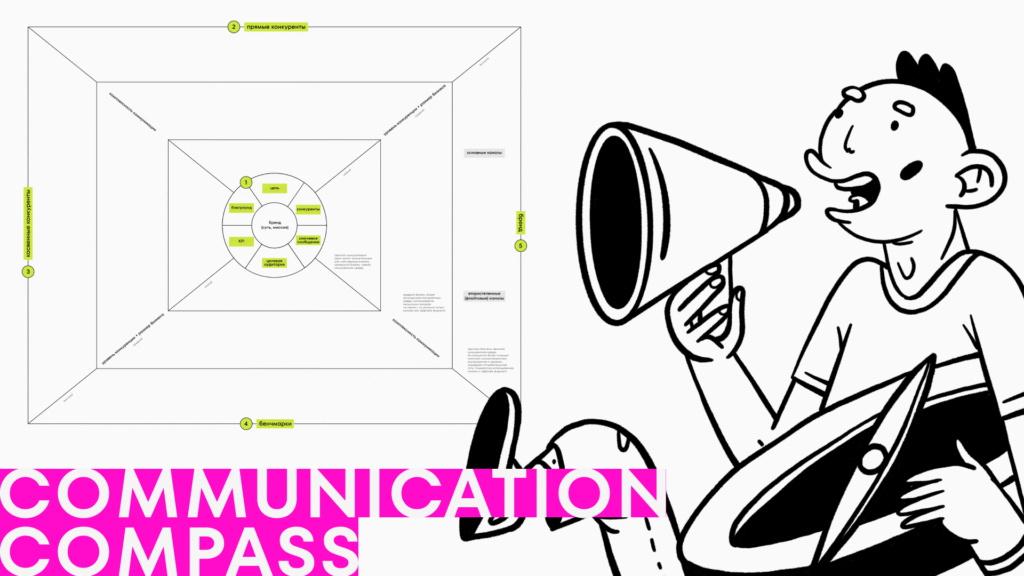
The Communication Compass is a methodology developed to solve this specific problem. It emerged from a study of 16 communication strategies and the discovery of a positive correlation between competition intensity, business size, and communication complexity.
The model maps brand communication against competitors across multiple channels and levels — direct competitors, indirect competitors, and category benchmarks. It’s structured in concentric layers, starting from the inner circle that defines the essence of the communication strategy: background, purpose, target audience, competitive environment, key message, and KPI. The outer layers then map how each competitor plays across every significant channel.
The output is a visual representation of the communication landscape — which channels are saturated with competition, which channels are underutilized but have real potential, where the gaps are between your current communication and where you could credibly operate.
This matters because it turns channel selection from a budget conversation into a strategic decision. Instead of asking “how much should we spend on LinkedIn?” the question becomes “which channels are genuinely available to us, and which ones are so crowded that we’d need to spend significantly more than competitors just to be heard?” Those are very different questions. They produce very different answers. Read more about the methodology here.
AI for Hypothesis Testing: Where We Use It and Why
A reasonable question to ask any brand strategy agency in 2026 is: where does AI fit in your process?
The honest answer — and the only useful one — is that AI belongs in hypothesis testing, not in strategic judgment. We use AI-assisted tools to pressure-test positioning hypotheses: to model how a particular message might land across different audience segments, to run pattern recognition across large bodies of competitor communication, to accelerate the data gathering that would otherwise take weeks of manual research.
What AI doesn’t do, and can’t do at the level required for serious brand strategy, is determine what a brand should stand for. That requires understanding the business’s actual capabilities, the founder’s genuine beliefs, the emotional texture of the category, and the specific gap that exists between what customers want and what the market currently offers. These are judgment calls. They require experience and a point of view.
Agencies that claim AI has replaced their strategic process are either confused about what strategy is or hoping you are. Agencies that refuse to use AI tools at all are leaving analytical capability on the table. The right position is in between: AI as an accelerant for research and hypothesis validation, human judgment as the irreplaceable engine of strategic direction.
Project Management: The Structural Advantage Most Clients Undervalue
Creative work is notoriously difficult to manage. Scope expands. Versions multiply. Feedback loops create confusion about which direction is current. Files get lost. Decisions made in one meeting contradict decisions from the previous one.
Most agencies manage this with email threads and shared folders, which is to say they manage it poorly. The client experience of this is familiar: unclear deliverables, missed timelines, confusion about what’s been approved.
We run all brand strategy projects through Branditex — a dedicated brand strategy platform that brings the entire brand development process into a single structured environment.
The core of Branditex is the Brand Platform module: an interactive pyramid that covers all seven strategic layers of a brand — Purpose & Mission, Vision, Positioning, Values, Personality, Brand Essence, and Visual Identity. Every field in the pyramid is connected. When positioning is updated, it syncs automatically across the Compass analysis, the Positioning Map, and the Communication Tone settings. Nothing falls out of sync. The completeness progress bar shows, at a glance, which sections are complete and which still require input.
The practical benefit for clients: full visibility into where the project stands at any moment, without needing to request status updates. The document trail is transparent. Approved decisions are locked. Revisions are tracked. The PDF and print export function means the final brand platform is ready to distribute the moment it’s completed.
For a client who has experienced the alternative — the shared folder chaos, the email chain archaeology, the “which version is final?” confusion — this is an immediate and material improvement in how the work feels to be part of.
The Questions Worth Asking Before You Sign Anything
Before committing to a brand strategy agency, ask them five things:
- How do you conduct competitive analysis? A vague answer about “research” is a yellow flag. Specific tools, named methodologies, and concrete outputs are what you’re looking for.
- Can you show me a brand platform you’ve developed — not just the identity, but the strategic document? Portfolios show visual output. Platforms show strategic thinking. You need both.
- How do you test whether a positioning idea is correct before committing to it? If the answer is “we present options and you choose,” walk away. Strategic positioning isn’t a menu.
- Who will actually work on my project? Senior-presented, junior-delivered is the oldest bait-and-switch in the agency business. Confirm names and seniority.
- How do you manage the project and how will I see progress? The answer tells you more about how the engagement will feel than any sales presentation.
What Good Looks Like
A brand strategy agency worth hiring makes you feel slightly challenged in the early conversations — not uncomfortable, but genuinely questioned. They push back on assumptions. They say “that’s an interesting claim — what’s the evidence for it?” They want to understand your business before they talk about your brand.
The output they produce should be something your whole team can understand and use, not a creative artifact that only the agency fully grasps. Real brand strategy doesn’t require interpretation. It’s clear, specific, and actionable — and it makes every subsequent decision about the brand easier, not harder.
That’s the standard. Hold agencies to it.