I want to be honest about something before we get into the cases. I am not a developer. I don’t write production code. I run a branding agency, I think in strategies and visual systems, and until fairly recently my relationship with software was strictly as a user — someone who buys tools, not builds them. That changed when I started working seriously with Claude for Small Business.
Over the past month I’ve built four functional web-based tools using Claude as the primary development partner. Not prototypes. Not internal experiments. Tools that are live, used by real teams, and that replaced manual processes that were costing us hours every week. The experience changed how I think about what a small business can actually build — and how fast.
The numbers support the shift. According to the Small Business & Entrepreneurship Council’s 2025 survey, 88% of small businesses now report using AI tools, and 73% say those tools have been important to their competitiveness and growth. Usage of generative AI among small firms jumped from 40% in 2024 to 58%+ in 2025 (Colorwhistle, 2026). Among SMBs specifically, Claude adoption surged 40% year-over-year (SQ Magazine, 2025).
The window is open. Here’s what we built while it was.
Case 1: Branditex — Enterprise-Grade Brand Strategy Tools for Everyone
The first thing that frustrated me about brand strategy software was that all the good tools were built for large agencies or enterprise marketing departments. The tools that structured brand platform development, competitive mapping, positioning work — those either didn’t exist as standalone products or cost enough to require a procurement process.
I’d been using a paper-based version of the Communication Compass — our proprietary framework for mapping competitor communications and finding positioning white space — for years. It worked. It just didn’t scale, couldn’t be shared in real time, and required someone to rebuild it from scratch every new project.
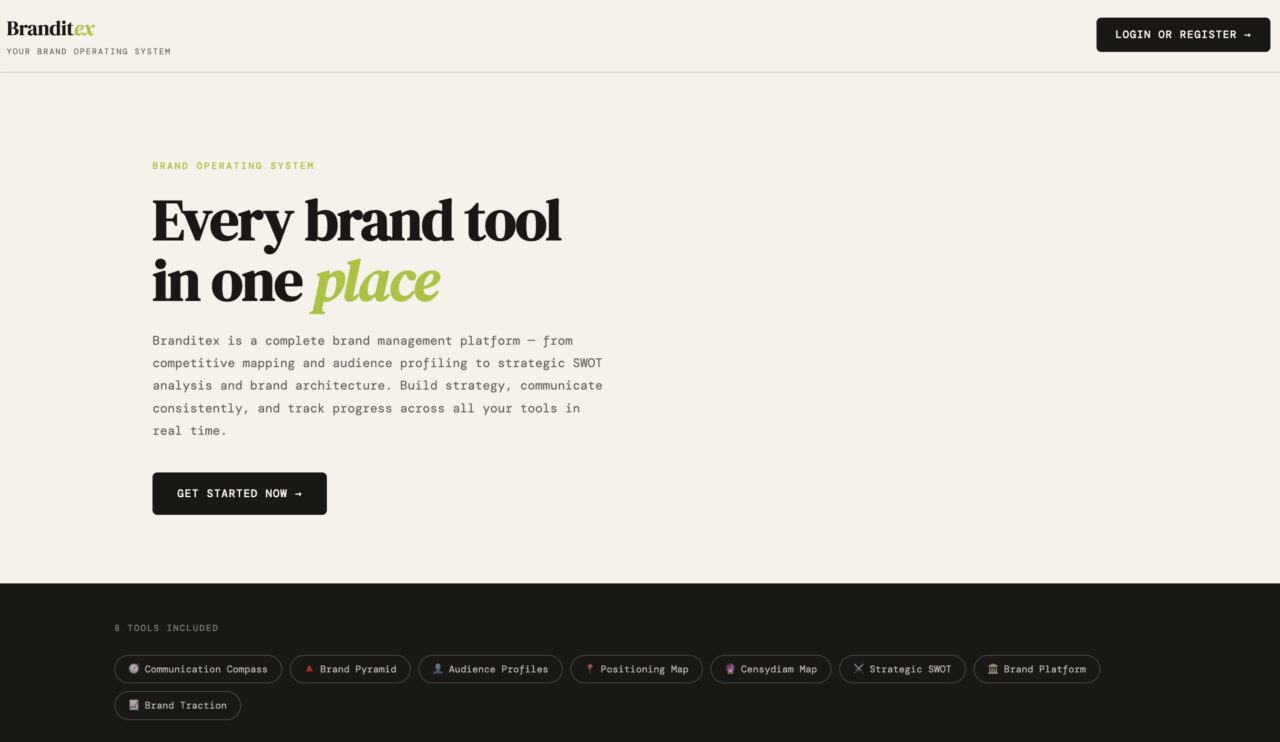
With Claude for Small Business, I built Branditex — a browser-based brand strategy platform built around the tools our agency actually uses.
The core is the Brand Platform pyramid: a 7-section interactive document covering Mission, Vision, Positioning, Values, Voice, Brand Essence, and Visual Identity. Every field is connected — when you update your positioning, it syncs automatically across the Communication Compass profile, the Positioning Map, and the Communication Tone settings. A completeness progress bar shows what’s done and what still needs input. The whole thing exports to PDF or print.
This is the kind of tool that previously existed only inside expensive enterprise software suites or required a custom development agency and a four-month timeline. Claude built the first working version in a fraction of that time, at a fraction of that cost.
The point worth emphasizing: these are premium-level strategic tools that are now accessible to a solo consultant, a two-person startup, a small marketing team. The technology gap between small businesses and large ones just narrowed significantly.
───
Case 2 of Claude for Small Business: The Moloko Agency Financial System — Killing Excel for Good
The second project was internal and embarrassingly overdue.
For years, the financial and project management accounting for our agency — Moloko — lived in Excel. Multiple spreadsheets. Formulas that broke when someone edited the wrong cell. Version control that was essentially “whoever saved last wins.” Time spent maintaining the system rather than running the business.
I built a custom financial and management accounting system for the agency using Claude. It tracks projects, project stages, team assignments, time allocation, billing status, client payments, and profitability by project and by period. Everything connects. A project manager can see real-time status without asking someone to pull a report. Finance can see outstanding invoices without opening three files.
We called it Branding Sidekicks internally — because it became the operational backbone that runs alongside every creative project.
What changed: the hours previously spent on formula maintenance, cell formatting, and version reconciliation now go toward actual project work. The cognitive load of “I need to update the spreadsheet” — which sounds minor until you calculate how many times a week it happened — simply went away.
Excel is still there. It’s used for one thing: exporting data when someone needs it in that format. That’s the right role for Excel in a modern small business operation. It’s a data format, not a management system.
───
Case 3 of Claude for Small Business: Reditorka — A Newsroom Management System Built for Real Editors
The third project came from a different pain point: editorial chaos.
Media teams — even small ones — face a specific operational problem. Content planning lives in one place. Payment tracking for contributors lives somewhere else. Staff profiles and rates are in a third location. Performance data doesn’t exist at all or requires someone to manually compile it each month.
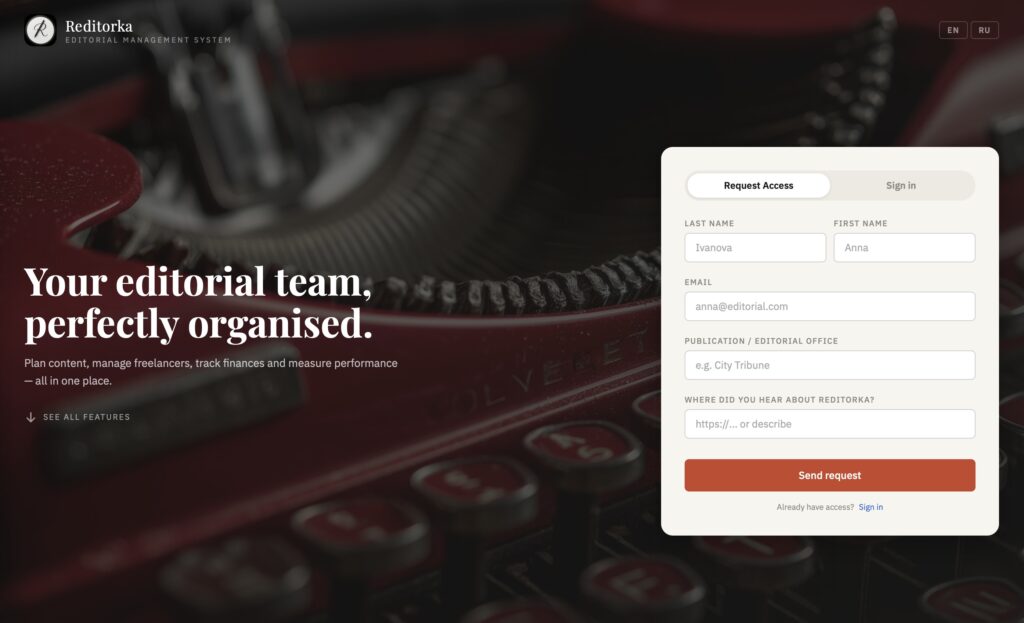
Reditorka.com is a newsroom management system that puts all of it in one place. Six modules:
Editorial Planning — a drag-and-drop calendar with priority rankings, material types, and publication status tracking. No more editorial planning in Google Sheets with color-coded cells that mean different things to different people.
Financial Control — every payment to staff and freelancers tracked in one place. Mark as paid, export to PDF or Excel by month. One source of truth for who’s owed what and when it was settled.
Staff & Freelance — complete profiles with bank details, IBAN, rates, and contract type. Payments link directly to people, eliminating the reconciliation process that normally happens at month-end.
Topic Pool — a holding area for story ideas not yet scheduled. Store them, add context, promote to the calendar when the timing is right. Ideas stop getting lost in Telegram chats.
Performance Analysis — monthly bar charts, publication counts by type, best month comparisons. A small editorial team can see at a glance whether they’re hitting their output targets without building a report.
Access Roles — editor, accountant, journalist each see only what they need. Permissions assigned per user in a single table.
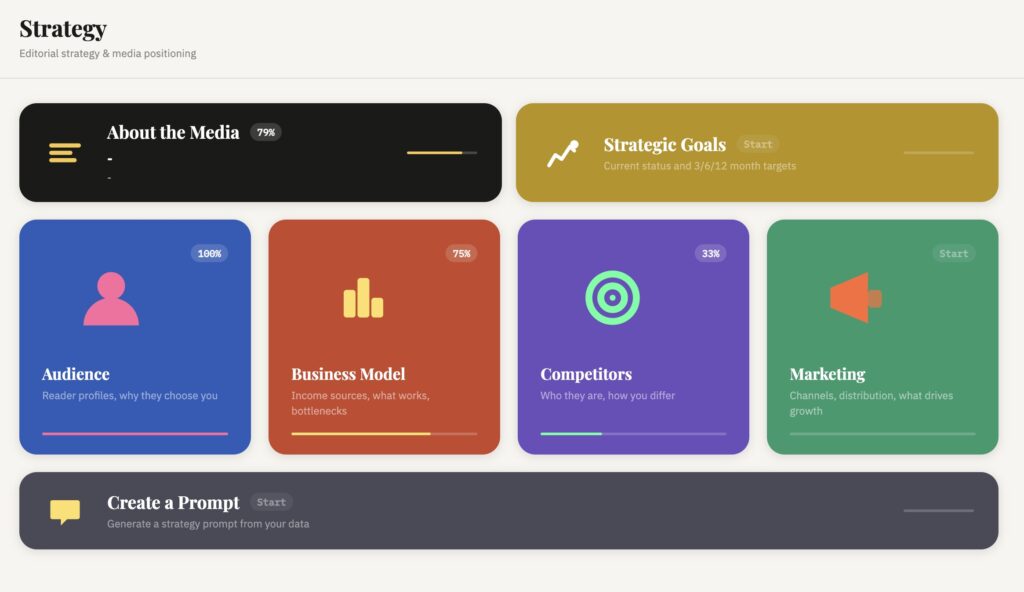
Reditorka also includes six built-in AI strategy prompts — structured prompts that pull from your actual media data and generate strategic analysis: competitor assessment, audience validation, marketing channel recommendations, and a complete strategy document. These aren’t generic AI prompts. They’re calibrated to what the system knows about your editorial operation.
This is a tool that a media startup or small independent publisher could have used for years. It didn’t exist in affordable, accessible form. Claude made it buildable.
───
Case 4 of Claude for Small Business: The Marketing Calculator — Campaign Planning Without the Spreadsheet
The fourth project is the simplest to explain and possibly the most immediately useful for the widest range of businesses.
Planning a media campaign used to mean building a calculator in Excel. Define your channels, input CPM or CPC rates, set your budget, build formulas that calculate reach, frequency, projected conversions, and cost per acquisition. Then share it with the client, who would edit something, break a formula, and send it back.
I built a browser-based marketing calculator that handles all of this in a clean interface. You input your budget, select your channels, plug in your rates and targets, and the calculator produces a structured campaign plan with projected outputs. It’s simple to use for planning any advertising campaign — no formula knowledge required, no cell formatting, no version confusion.
Excel’s role in this workflow is now exactly what it should be: an export option for people who need the data in that format. The planning, the thinking, the iteration — that happens in the tool.
For a small business owner who needs to plan a campaign without a media agency, this is the kind of tool that previously didn’t exist in accessible form. Now it does.
───
5 Reasons Claude Is a Genuine Competitive Advantage for Small Businesses
Beyond the specific cases, here’s what working with Claude as a build partner has demonstrated:
1. It eliminates the developer dependency for tools that don’t need a dev team.
Most internal business tools — calculators, trackers, management systems — are not technically complex. They’re just time-consuming to build if you’re starting from code. Claude collapses that timeline dramatically. A tool that would require weeks of developer time can be built, tested, and revised in days.
2. It makes premium tooling accessible at small-business scale.
The tools enterprises have — structured brand platforms, editorial management systems, financial dashboards — have historically required either expensive software subscriptions or custom development. Claude-assisted development changes that equation. The entry cost drops by an order of magnitude.
3. It removes the operational overhead of workaround systems.
Every spreadsheet that serves as a management system is a liability. It breaks, it requires maintenance, it depends on one person who knows how it works. Purpose-built tools remove that fragility. Claude makes building purpose-built tools feasible for businesses that couldn’t previously justify the investment.
4. It accelerates the feedback loop between idea and implementation.
In a small business, the person with the operational insight — the person who knows exactly what the tool needs to do — is often the founder or a senior team member. Claude lets that person build directly from that insight rather than translating it through a developer who doesn’t have the same context. The result is tools that actually match the real workflow.
5. It creates compounding advantage over time.
The businesses that start building operational infrastructure with AI assistance now will have a significant head start in 18–24 months. The J.P. Morgan Chase Institute found that businesses adopting AI tools in 2024 started at $20/month — a 60% cost reduction compared to 2019 entry points. The tools are accessible. The question is whether small businesses use the access.
───
If You Have a Small Business and Want to Build Something Claude for Small Business
Everything above — Branditex, the Moloko financial system, Reditorka, the marketing calculator — started with the same process: a clear problem, a clear description of what the tool needed to do, and Claude for Small Business as the build partner.
I’ve worked through this process enough times to know where it’s efficient, where it requires iteration, and how to structure a build so the output is actually usable rather than just functional.
If you have a small business and want to build a tool that would genuinely improve how you operate — a calculator, a tracker, a client-facing system, a management dashboard — I can help you think through the brief, the architecture, and the build process.
The advantage is real. The timing is right. The only thing missing is the decision to start.