I’ll be honest — the first time a client asked us to develop a board game for business, I thought it was a one-off creative experiment. Something fun, something tangible, a nice break from logo systems and brand guidelines. That was a wrong read. After developing games for HR departments, branded Monopoly-style formats for major companies, a card game for a genuine music obsessive, and a full cyberpunk board game for a DeFi crypto brand — I understand now that a board game is one of the most underestimated branding and communication tools available to a business.
Not because board games for business are trendy. Because they work on a fundamentally different psychological level than any other branded object.
Why Games Hit Differently Than Conventional Marketing
A brochure gets read once, if at all. A branded pen lives in a drawer. A corporate video gets skipped after six seconds. A board game gets played — for 45 minutes, with full attention, often repeatedly, always in social context.
The engagement gap between a board game and conventional marketing collateral is not incremental. It’s categorical.
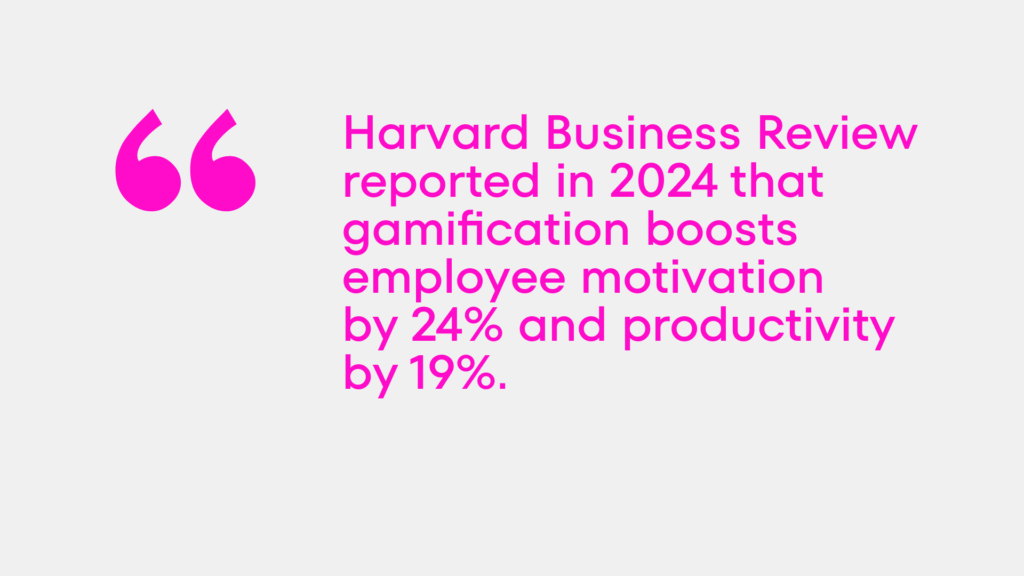
Gamification research from AmplifAI (2026) confirms this: organizations with the right gamification elements in place see a 50% rise in workforce productivity and a 60% increase in employee engagement. Harvard Business Review reported in 2024 that gamification boosts employee motivation by 24% and productivity by 19%. And 83% of employees who receive gamified training feel motivated at work, compared to only 61% of those receiving non-gamified training.
These numbers come from digital gamification — points, badges, leaderboards. Physical board games, with their tactile engagement and face-to-face social dynamics, deliver something even more durable: memory. People remember what they experienced together around a table in a way they simply don’t remember a slideshow.
The global board game market reached $12.8 billion in 2025 and is projected to hit $20.6 billion by 2034 (CoopBoardGames, 2025). Business is a significant and growing driver of that number — for training, brand activations, corporate gifting, and community building.
How Companies Actually Use Board Games
There are several distinct use cases, and they require different design thinking.
HR and training games are built around specific knowledge transfer or behavioral objectives. Onboarding a new team to a complex product? A game that runs on the actual concepts and terminology teaches while it entertains. The mechanics reinforce the content — correctly answer or guess a term, and the team advances. Get it wrong, and the knowledge gap becomes visible in a low-stakes, low-embarrassment context. Gamified training produces measurably better retention than lectures or manuals. We’ve developed these for HR departments that needed to explain complex internal processes, compliance frameworks, and company culture to new hires without putting them to sleep.
Branded games function as marketing objects. The most recognizable format is Monopoly — and for good reason. The Monopoly segment alone generated $3 billion in revenue in 2024 (GMInsights). A brand that commissions its own Monopoly variant gets a game that lives in homes and offices, referenced in conversations, brought out at gatherings. Every time it’s played, the brand is present — not as advertising, but as the game itself. That’s a fundamentally different relationship with an audience than a sponsored banner ad.
Event and community games create shared experiences around a brand’s world. These work especially well for companies with a defined culture, aesthetic, or ideology that they want people to actually inhabit rather than just observe.
Corporate gifting — a custom-designed game as a gift to partners, clients, or employees — generates the kind of emotional response that a branded USB drive or a calendar simply cannot. 71% of businesses report increased brand loyalty from personalized gifting (Blackhawk Network, 2026). A game that’s thoughtfully designed around the recipient’s world lands as a gesture, not a transaction.
DeFinity: When a Crypto Brand Entered the Game
One of the most interesting briefs we’ve received came from 1Inch — one of the major names in DeFi (decentralized finance). The task: create a board game that immerses players in the world of DeFi through interactive gameplay. Not a tutorial. Not an explainer. A game that makes the culture of crypto feel alive.
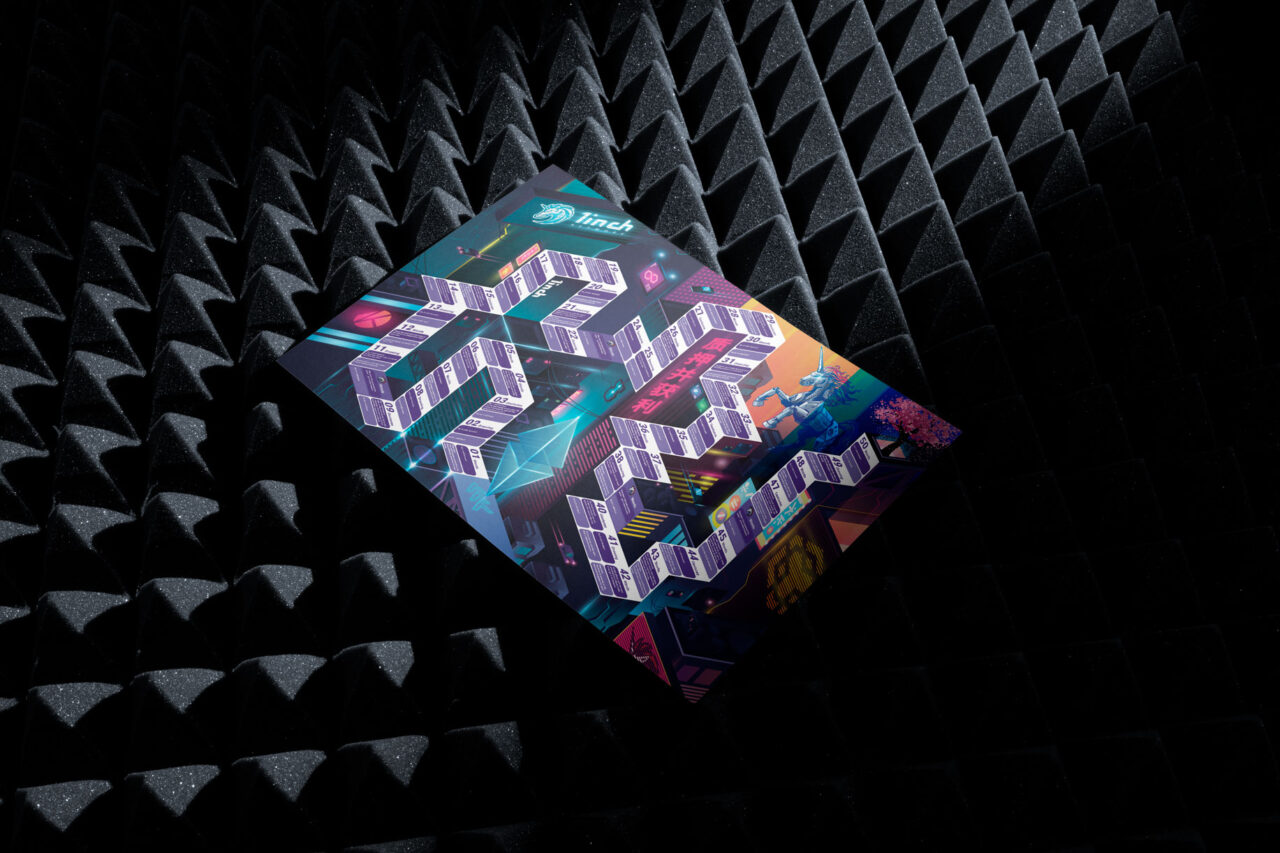
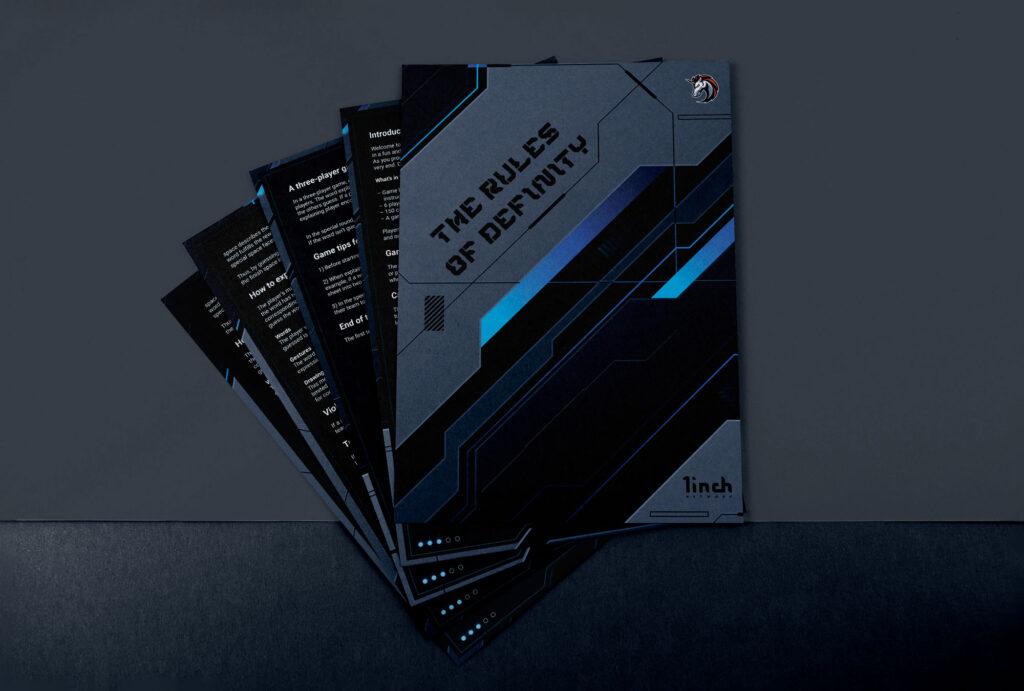
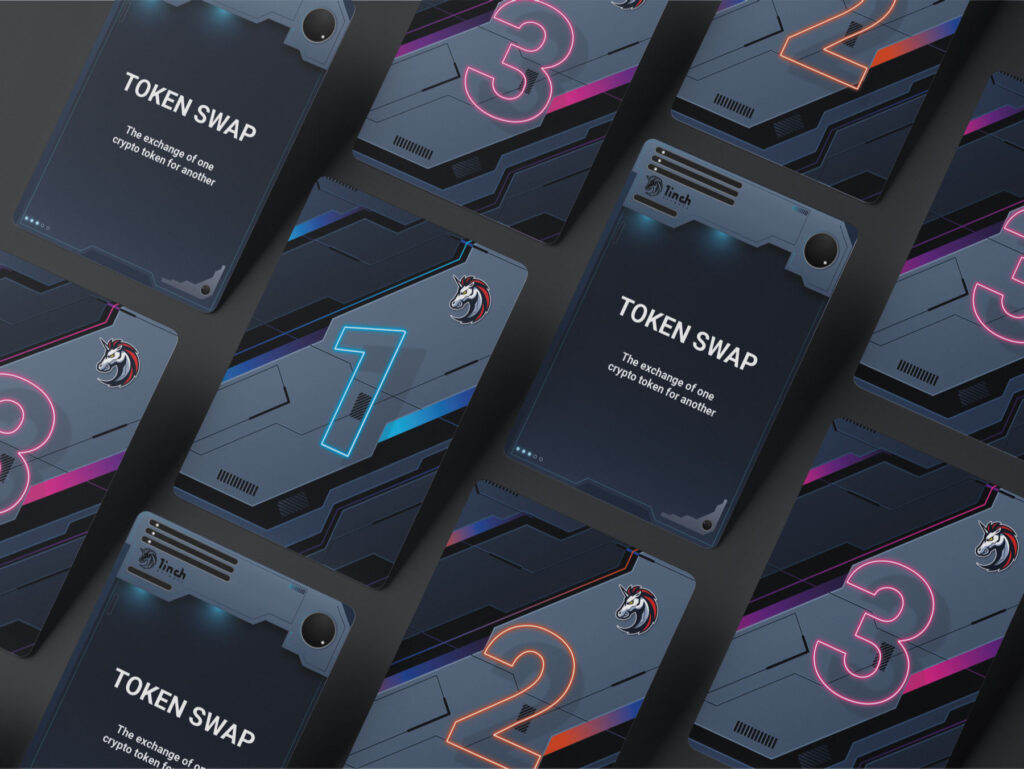
The result was DeFinity — a large-format board game where teams compete to guess and explain DeFi terminology against the clock. Three levels of difficulty. Team-based mechanics. Unpredictable elements: the difficulty of each round is determined by the roll of the dice, the method of explanation by which cell the team lands on. When a team lands on the 1Inch cell, a special competitive round begins — designed so that only your team can score.
The visual world of DeFinity was built in isometric style — a futuristic 1Inch city with neon accents drawing directly from the cyberpunk aesthetic of Blade Runner. The playing field is a detailed environment that players inhabit, not just navigate.
This is what a brand game looks like when it’s built with genuine creative direction behind it: the mechanics reinforce the brand’s identity (complex, intelligent, community-driven), the visual world expresses the brand’s aesthetic, and every round deepens familiarity with the terminology that defines the product. Players don’t feel like they’re being educated. They feel like they’re inside something. See the full project here.
Fanatka: A Game Built in 14 Days for Someone Who Deserved It
Not every game brief starts with a brand strategy session. Sometimes it starts with a person.
Dasha Puteyko is, by any measure, an obsessive music fan. Collector of festival trophies. Veteran of hundreds of music adventures. The task was to create a creative birthday gift — music-related, meaningful, delivered fast.
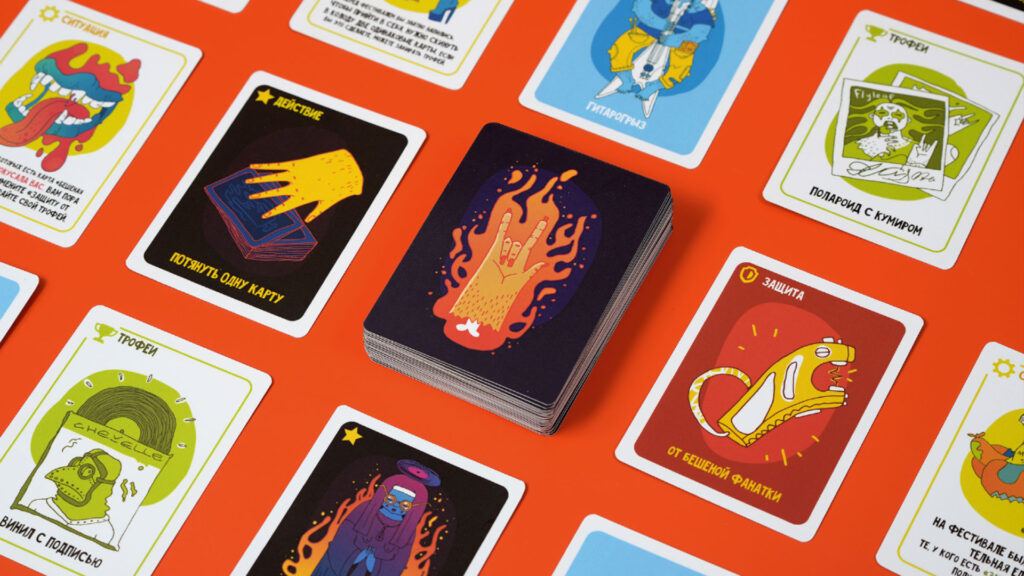
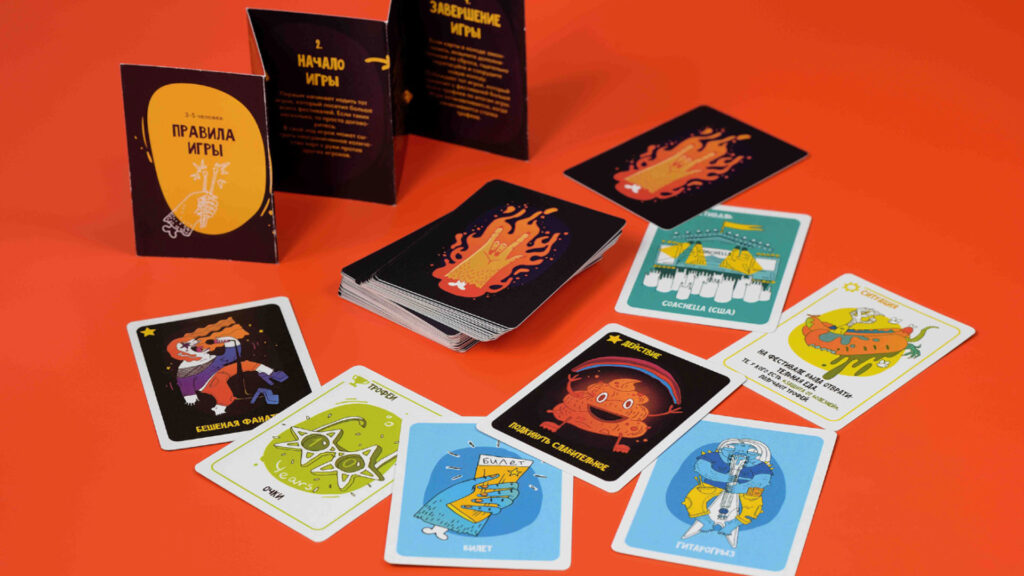
The entire game — mechanics, illustrations, print — was completed in 14 days. Fanatka (which translates roughly as “The Fan Girl”) is a card game built from the real chaos of festival life: getting caught in the rain, losing tickets, eating questionable food, surviving experiences that become the best stories. The game doesn’t glamorize the festival experience. It celebrates the absurdity of it — which is exactly why people who love music recognize themselves in it immediately.
Fanatka exists currently as a solo run. But the concept — a game built around a specific, passionate subculture — is precisely the format that scales. Niche audiences with strong identity and shared language are ideal board game communities. See the project here.
What Makes a Business Board Game Actually Work
After building games across formats, audiences, and industries, the pattern is consistent. The games that work share three properties:
The mechanics serve the message. In DeFinity, guessing and explaining terminology IS the game — which means every turn is a training moment disguised as competition. In a well-designed HR onboarding game, the mechanics mirror the real decisions employees will face. The game doesn’t just carry the content — the game IS the content.
The visual world has genuine ambition. A branded game that looks like a hastily assembled template communicates exactly one thing: this company didn’t care enough. A game designed with real creative direction — original illustration, a coherent visual universe, quality materials — communicates the inverse. It says the brand takes craft seriously, which is a brand statement in itself.
The audience is specific. Games designed for everyone tend to land with no one. The best business board games are built for a clearly defined group — whether that’s a DeFi community, a company’s new cohort of engineers, a music festival obsessive, or a brand’s top-tier clients. Specificity is what makes a game feel like it was made for you rather than at you.
The Brief for Your First Board Game for Business
If you’re considering a board game as a business tool — for HR, for marketing, for a brand activation, for a client gift — the starting brief should answer three questions:
Who is playing this, specifically? What do you want them to know, feel, or remember when the game ends? And what does your brand world look like when it becomes a place people can actually inhabit?
The last question is the one most companies underestimate. A board game for business is a brand extension. Everything inside it — every card, every illustration, every rule, every moment of tension — is an expression of who you are. Done right, it’s the most effective brand touchpoint you’ll ever produce. Done without intention, it’s just cardboard.