“Sooner or later, I’ll do it. I’ll think I can do it sooner.” A client said that to me once — maybe three years into our agency’s existence — when I asked why they’d been putting off the brand strategy process by steps work. It stuck. Not because it was funny, though it was, a little. It stuck because I’ve heard versions of that sentence from almost every company that came to us having waited too long. The confidence is genuine. The timing is always optimistic. And the cost of the delay is always higher than anticipated.
Over 10 years of running this agency, every brand project we’ve worked on has moved through many of the same stages. The industry changes. The tools evolve. The clients come from wildly different markets. But the process — the actual sequence of decisions that transforms a company’s fuzzy self-understanding into a clear, marketable brand — remains remarkably consistent. Because human psychology doesn’t update with software releases. People still buy from brands they understand, trust, and feel something about.
What follows is that process, laid out without the mystification agencies sometimes add to justify their fees.
───
Step 1 of Brand Strategy Process by Steps: Discovery — Understanding Before Deciding
Every brand strategy process by steps begins with listening, not presenting. This sounds obvious. It’s consistently ignored.
Discovery is the phase where we stop assuming we know what the business is and start actually finding out. That means structured interviews with founders, senior leadership, and frontline staff. It means listening to how salespeople describe the product when they think no one is evaluating them. It means reading customer reviews with genuine curiosity — not for testimonials to cherry-pick, but for language patterns, frustrations, and unspoken expectations.
The question driving discovery isn’t “what do you want the brand to be?” It’s “what is actually true about this company that is worth saying out loud?” Those two questions produce very different starting points.
According to research from Prowly’s 2025 Brand Research Guide, companies that invest in structured brand research before positioning see significantly stronger messaging alignment across departments. The brands that skip discovery are the ones whose internal and external communications contradict each other by month six.
Discovery output: a raw intelligence document — messy, honest, full of tensions and contradictions. That’s exactly right. Tension is where positioning lives.
───
Step 2 of Brand Strategy Process by Steps: Audience Definition — Not Demographics, Psychographics
Most companies think they know their audience. Most are describing a demographic, not a person.
“Women 25–45 with disposable income” is not an audience definition. It’s a census category. A real audience definition captures what that person believes about the world, what they’re trying to accomplish, where they feel underserved, and what would genuinely change something meaningful in their professional or personal life.
This distinction matters enormously for the brand strategy process because positioning built on demographics produces generic messaging. Positioning built on psychographics produces recognition — that specific feeling a prospect gets when they read your copy and think this is for me.
Research from FreshSparks and multiple consumer behavior studies confirms that 71% of consumers prefer buying from brands that align with their values. Values alignment requires knowing what your audience values, not just how old they are and where they live.
We create what we call audience portraits rather than persona cards — narrative descriptions of the human we’re trying to reach, written in language we’d use if we were describing a real individual to a colleague.
───
Step 3 of Brand Strategy Process by Steps: Competitive Mapping — Finding the White Space
Every market has a dominant visual and verbal language. Tech brands tend to gravitate toward clean minimalism and language about “powering,” “enabling,” or “transforming.” Financial services talk about security, growth, and trust. Wellness brands use softness, nature, and community.
Competitive mapping isn’t about studying competitors to copy them — it’s about understanding the category language well enough to identify what’s been left unsaid. Where is everyone going left? That’s where we consider going right.
This step produces a competitive landscape map: a visual representation of how current players are positioned across two or three key axes. The white space on that map is strategically valuable territory. It’s where a new brand can step in and be heard clearly, without having to shout over everyone else saying the same things.
One pattern we see constantly: companies are surprised by how similar their competitors look and sound when laid out side by side. Differentiation sounds difficult until you see how low the bar actually is in most categories.
───
Step 4: Brand Positioning
Positioning is the heart of the brand strategy process. Everything else is infrastructure built around it.
A strong brand position answers a single question: why this brand, for this specific person, over every alternative available to them right now? The answer has to be specific, credible, and ownable — not aspirational, not borrowed from a trend, not so broad that it applies equally well to a dozen other companies.
The positioning statement we develop isn’t marketing copy. It’s an internal compass — a precise sentence that describes the competitive space, the target audience, the primary benefit, and the proof point. It’s rarely seen publicly. Its job is to make every downstream creative decision easier and more consistent.
The discipline required at this stage is ruthless. We push clients to cut. Cut the secondary audience. Cut the adjacent capability. Cut the positioning claim that sounds good but isn’t credibly owned. Breadth at the positioning stage is the enemy of everything that comes after it.
A well-defined position doesn’t just help marketing. McKinsey’s 2024 consumer research found that 76% of purchase decisions are influenced by branding at the first consideration moment. Positioning determines whether you’re on the consideration list or invisible.
───
Step 5: Brand Architecture
Before messaging can be built, the architecture needs to be clear: how does this brand relate to its products, sub-brands, or service lines? Is everything unified under one master brand? Does each product carry its own distinct identity? Is there an endorsement relationship?
This matters operationally. Getting brand architecture wrong at the strategy stage means expensive corrections later — naming conflicts, visual inconsistencies, customer confusion about what the brand actually covers.
Most growing companies don’t think about architecture until they’ve already created a mess of it. We make it explicit in the process so the structure supports, rather than fights, the story being built on top of it.
───
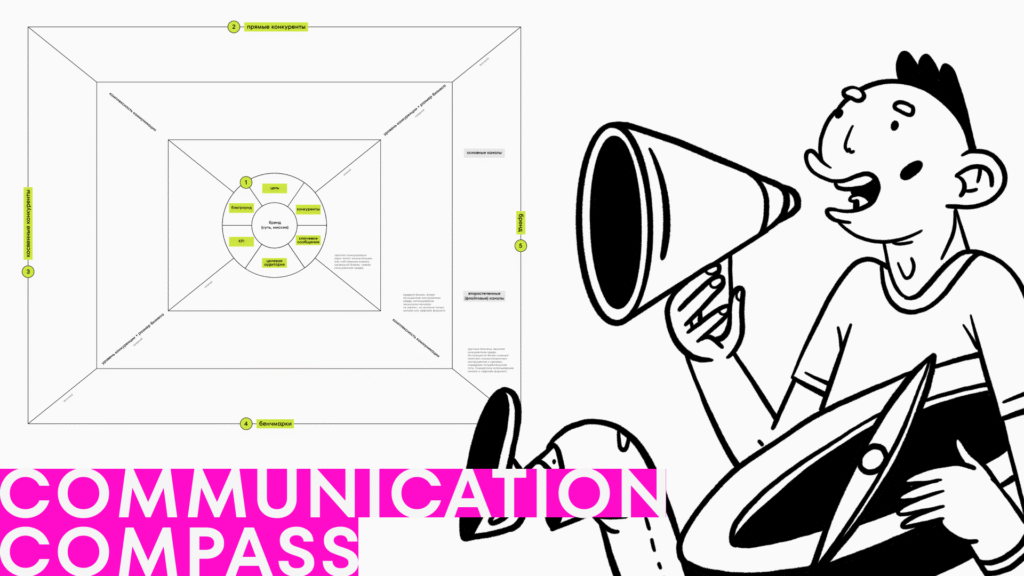
Step 6: The Communication Compass
This is the tool I’m most attached to. Not because we invented the concept, but because of how consistently it works when properly built.
The Communication Compass is a messaging framework that sits between the positioning statement and actual market-facing copy. It defines four things:
1. Where do we speak?
2. Who are our competitors and what are they saying?
3. What are our competitors’ unique selling points?
4. Which channels can be unique to us?
The Communication Compass becomes the brief for every campaign, every copywriter, every external agency, and every social media manager. It’s the reason that companies with 40 people in marketing can still sound like one voice rather than a committee. Without it, voice fragmentation is guaranteed within 12 months of scaling.
───
Step 7: Visual Identity System
Strategy becomes visual at this stage. Logo, color palette, typography, imagery direction, iconography — these aren’t aesthetic choices. They’re strategic ones, made in response to everything discovered and defined in the steps above.
The brief to the visual design team isn’t “make it look premium” or “we like this shade of blue.” It’s: here’s our positioning, here’s our audience, here’s our competitive white space, here’s our tone of voice — now build a visual language that makes all of that legible at a glance.
Lucidpress data consistently shows that companies maintaining visual consistency across all channels see revenue increases of 23–33%. Visual identity isn’t decoration. It’s the fastest-loading signal of everything your brand stands for — and consistency is what makes that signal compound over time.
───
Step 8: Internal Alignment
The most expensive mistake in any brand strategy process is launching externally before aligning internally.
A positioning framework that leadership hasn’t genuinely internalized will fragment the moment it hits a sales call. Brand guidelines that the product team wasn’t part of building will be quietly ignored in how they describe features. Messaging frameworks left in a PDF on a shared drive are messaging frameworks that don’t exist.
We run an internal activation session before any external launch: a working session with cross-functional leadership, walked through the strategy, the reasoning behind it, and the practical implications for how each team communicates. This session surfaces misalignments before they become market-facing inconsistencies.
The goal: every person who speaks for the brand — in a sales call, a product demo, a customer service interaction, a LinkedIn post — operates from the same strategic foundation.
───
Step 9: Implementation and Measurement the Brand Strategy
A brand strategy that exists only as a document is not a brand strategy. It’s a PDF. Implementation means defining where and how the brand shows up — the priority touchpoints, the rollout sequence, the owners and timelines.
It also means defining what you’ll measure. Brand awareness in the target segment. Share of voice versus competitors. Net Promoter Score trajectory. Customer acquisition cost over a 12-month window as brand recognition builds. The specific metrics matter less than the commitment to tracking them — because brand strategy, unlike performance marketing, operates on a longer time horizon and requires patience backed by evidence.
The companies that build durable market positions don’t reassess their strategy after six weeks because the metrics haven’t moved yet. They build, stay consistent, measure quarterly, and adjust at the edges while holding the core.
───
The pattern after 10 years of the Brand Strategy
Here’s what a decade of running this process has taught me: the companies that get the most from their brand strategy work are the ones who come in ready to be challenged, not validated. They want to know what’s actually true and what’s worth saying — not a more polished version of what they already believe.
The ones who wait — who say “sooner or later, I’ll do it” — almost always arrive with more urgency and less runway than they’d have liked. The strategy still works. It just has more pressure on it.
Better to start the process when you have the space to get it right.