
There’s a particular kind of frustration I’ve seen in founders and marketing directors across dozens of projects. They’ve spent real money on campaigns. The creative looks good. The targeting is reasonable. The results are mediocre — and not in a “needs optimization” way, but in a “fundamentally not working” way. More budget doesn’t help. Different channels don’t help. A new agency doesn’t help. The problem isn’t the marketing. The problem is that there’s no develop positioning underneath it.
Marketing without positioning is noise with a budget. It reaches people. It doesn’t move them. Because there’s no clear answer to the question every potential customer is quietly asking: why should I choose this brand over everything else available to me right now?
Develop positioning answers that question. And until it does, every marketing dollar is doing partial work — finding the right people and then failing to give them a compelling reason to act.
This isn’t a theoretical problem. Companies that embrace advanced analytics and strategic brand foundations report 5–8% higher marketing ROI than competitors who skip the foundation layer (Firework, 2025). WARC’s 2026 data shows that campaigns built on clear brand positioning deliver ROI 67.4% higher than pure performance campaigns. The positioning work isn’t overhead. It’s leverage.
Here are the five reasons why develop positioning first — before a single campaign brief is written — changes everything downstream.
───
Reason 1: Audience Analysis Reveals Who You’re Actually Talking To
Most brands think they know their audience. They have a demographic profile. Maybe a few buyer personas created during an offsite three years ago. What they rarely have is a genuine understanding of the specific situations that make someone need their product — and the specific language those people use when they describe that need.
Audience analysis at the develop positioning stage goes deeper than demographics. It’s behavioral. The question isn’t “who is this person?” — it’s “when do they feel the problem your brand solves, and what are they thinking in that moment?”
This distinction matters enormously for develop positioning. A productivity software company that knows its customers are “professionals aged 28–45” can’t develop a positioning statement worth anything. The same company, after proper audience analysis, discovers that their best customers are specifically people who’ve just moved into a management role for the first time and are overwhelmed by the volume of coordination work — people who feel competent at their actual job but drowning in the admin layer. That insight produces a positioning claim that resonates. Demographics don’t.
The audience analysis phase of develop positioning work typically involves in-depth interviews, customer journey mapping, behavioral segmentation, and linguistic analysis — finding the actual words customers use to describe their problem. Those words are gold. They belong in your positioning, your messaging, and every campaign that follows.
Comprehensive market and audience research provides the insights necessary to position a brand effectively and create messaging that resonates (Monday.com, 2026). The research isn’t a box to check — it’s the input that makes the positioning true rather than invented.
───
Reason 2 for Develop positioning: Competitor Analysis Shows Where the Space Is
Here’s a pattern I’ve reviewed in dozens of competitive landscapes: every brand in a category uses the same four words. Quality. Reliability. Experience. Innovation. Some add “passion” or “customer-first.” None of it is differentiated because all of it is equally claimed by everyone.
When brands position themselves using category clichés, they’re not positioning at all. They’re describing themselves using the minimum credibility requirements of the category — the table stakes — and calling it strategy. Customers can’t distinguish between companies that all say the same things, so they default to price. The race to the bottom begins.
Competitor analysis in the positioning process isn’t about finding what competitors do. It’s about mapping the space they occupy — the claims they make, the channels they use, the audiences they address, the visual and verbal territory they’ve colonized — and finding what they’ve left open.
This is the function of the Communication Compass methodology: to map competitor communication across every relevant channel, layer by layer, from direct competitors to indirect ones to category benchmarks. The output isn’t a table comparing features. It’s a visual landscape that shows, clearly, where the category communication has converged and what white space remains unclaimed.
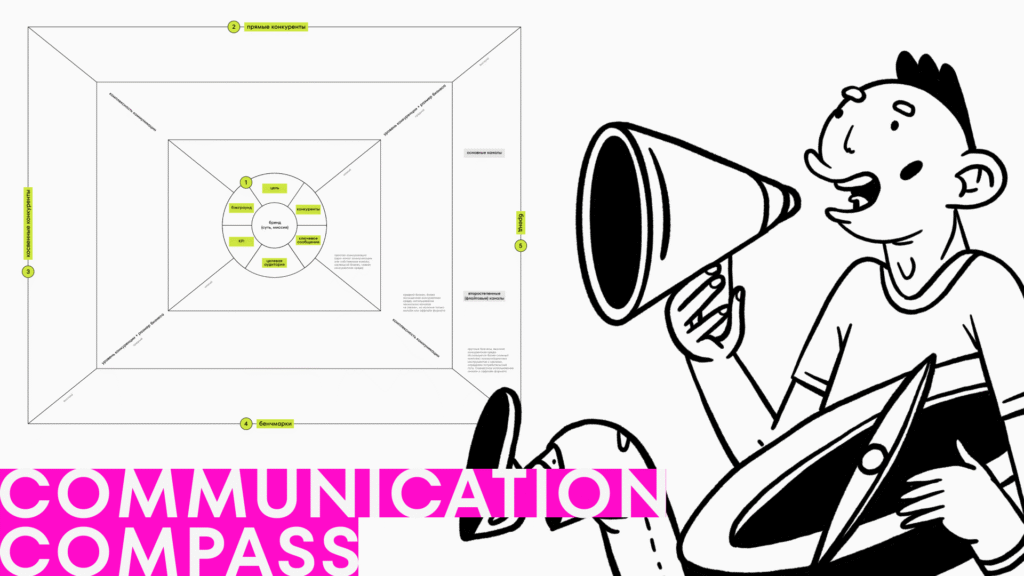
Positioning that emerges from this analysis is defensible. It’s not based on what sounds good or what the founder feels passionate about. It’s based on what’s genuinely available — a real gap between what the market is offering and what a specific audience actually wants.
───
Reason 3 for Develop positioning: Product Analysis Connects Reality to Claim
Positioning has to be true. This sounds obvious until you see how often brands position themselves around claims their product can’t actually support.
The product analysis stage of positioning development is a rigorous internal audit: what does this product actually do better than alternatives? What is the specific mechanism of value — not the feature list, but the genuine outcome a customer experiences that they couldn’t get as easily elsewhere?
This stage reveals the RTB — Reasons to Believe. The proof points that make a positioning claim credible rather than aspirational. Without RTBs, positioning is just a sentence. With them, it’s an argument that can be made consistently across every touchpoint, because it’s backed by something real.
Product analysis also surfaces the things a brand shouldn’t claim — the areas where competitors genuinely outperform, where the product is average, where overclaiming would damage trust the moment a customer experiences the reality. Honest product analysis produces positioning that’s more modest than founders might initially want, and far more durable than the inflated version.
───
Reason 4 for Develop positioning: Founder Interviews Unlock What Research Can’t Find
This is the stage most positioning frameworks undervalue — and in my experience, the one that produces the most valuable inputs.
The people who built a business hold enormous amounts of knowledge that never makes it into a strategy document. They remember the specific customer conversation that first confirmed the product worked. They know exactly which problem they originally set out to solve and how it evolved. They understand the operational details that create genuine competitive advantages — the ones that are invisible to an outside analyst because they’re embedded in how the company actually works.
Structured in-depth interviews with founders and senior leadership, when done properly, surface the brand’s authentic story, its true competitive strengths, and the insights that distinguish it from companies that look similar on the surface.
I’ve conducted these interviews for years. Some of the most powerful positioning work I’ve been involved in came from a founder saying something almost offhand — a detail about how they approach a problem, a belief about the category that turned out to be widely held but never said publicly, a specific outcome their customers experienced that the company had never thought to put at the center of its story.
In-depth interviews are not a formality. They’re an intelligence-gathering operation. The brand’s most useful truths are often already inside the business. The positioning process is how they get out.
───
Reason 5 for Develop positioning: Clear Positioning Makes Everything Downstream Easier
This is the payoff — the reason positioning isn’t just a philosophical exercise but a commercial necessity.
Once positioning is defined — who the brand is for, what it claims, why that claim is credible, what makes it different — every subsequent marketing task becomes structurally simpler.
Writing campaign briefs: the brief has a positioning statement to brief against. Creative ideas can be evaluated against a clear criterion: does this bring the positioning to life, or doesn’t it?
Developing messaging for different channels: the positioning hierarchy tells you what to lead with (the primary claim), what supports it (proof points and secondary messages), and how to adapt for context without losing strategic coherence.
Briefing external agencies, freelancers, and AI tools: instead of hoping that a designer or copywriter intuits the brand correctly, you have a document that explains exactly what the brand stands for and why. The Communication Compass output tells them which channels to prioritize and why. The brand platform built in Branditex gives them every strategic section — mission, values, voice, essence — in a single, always-current reference.
Evaluating creative work: when a campaign or a piece of content is presented, the positioning statement is the filter. Does this idea communicate the right message to the right person? If yes, it moves forward. If not, it gets revised — not because someone’s preference overrode someone else’s, but because it doesn’t match the agreed-upon strategy.
Building the brand over time: positioning creates accumulation. Every campaign that aligns with the positioning adds to a coherent impression in the market. Customers start to associate the brand with a specific idea. That association is brand equity — and it’s built through repetition of a consistent, strategic message, not through a series of disconnected creative executions.
───
Positioning Is Not a Deliverable. It’s a Foundation.
There’s a tendency to treat positioning as one item in a project scope — something that gets done, checked off, and replaced by the “real work” of campaigns and creative. This misunderstands what positioning does.
Positioning is the foundation on which every other piece of brand and marketing work is built. It’s the reason a brief gets written the way it gets written. It’s the reason a design system makes the choices it makes. It’s the reason a campaign resonates rather than falls flat.
Without it, marketing is expensive guesswork. With it, every investment in awareness, consideration, and conversion is working from the same strategic direction — amplifying the same claim, building the same association, earning the same place in the customer’s mind.
Every brand needs positioning. Not because it’s theoretically correct, but because without it, the bottleneck never moves. Budget increases don’t help. New channels don’t help. Better creative doesn’t help. The constraint isn’t in the marketing. It’s upstream, in the absence of a clear answer to the most important question in the business:
What does this brand stand for, and why does that matter to the people it’s trying to reach?
Answer that first. Then go to market.