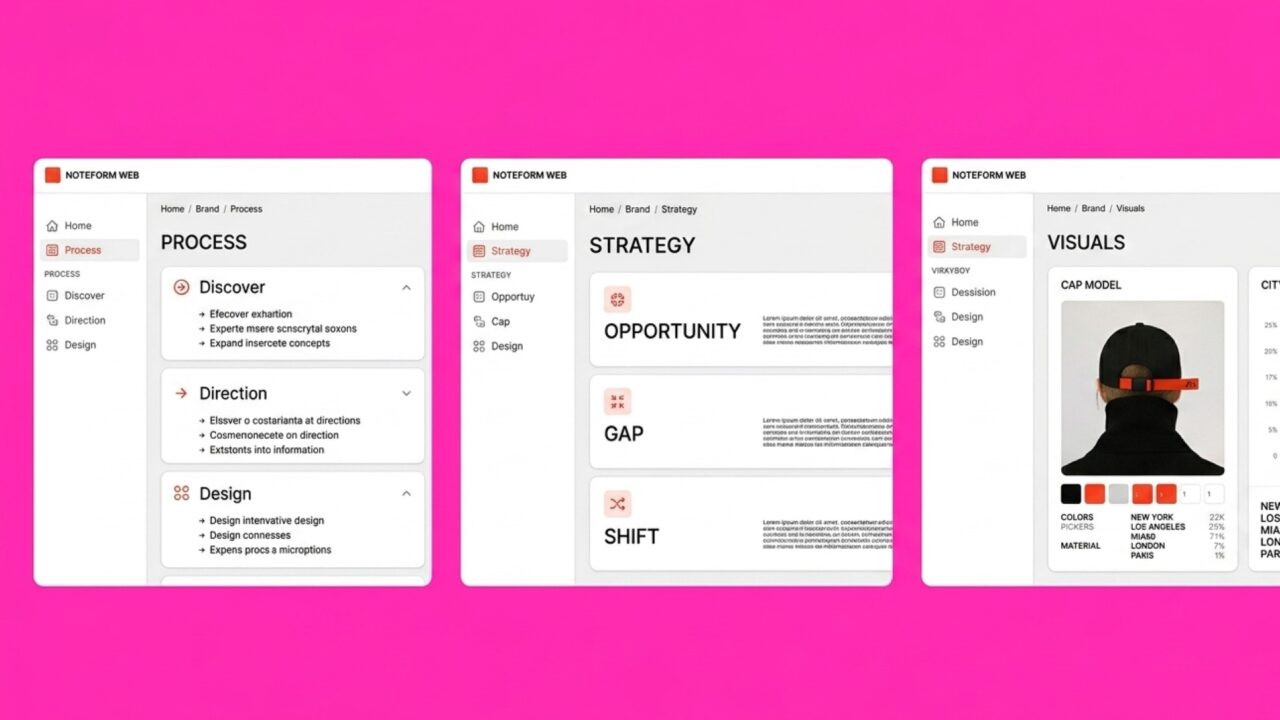
I still have a printed brandbook from a client project we did in 2017. Hardcover. Beautifully designed. Sat on a shelf for three years until someone threw it out during an office move. Nobody had opened it in two years because the logo had been updated, the color palette had been revised, and the contact information on the back page was wrong. The book was accurate on the day it was printed and wrong approximately six months later.
That’s not a failure of the design. That’s the fundamental problem with any static document pretending to govern a living system.
The question “digital brandbook vs. printed brandbook” sounds like a formatting debate. It isn’t. It’s a question about whether your brand system can actually function in the conditions under which modern businesses operate: distributed teams, remote contractors, frequent iterations, multiple agencies working in parallel, and AI tools that need structured brand data to produce consistent output.
Printed brandbooks can’t function in those conditions. The digital brandbook isn’t just a better format — it’s a different category of tool entirely.
What a Printed Brandbook Actually Does
Be precise about this: a printed brandbook is an artifact. It documents a moment in the brand’s development with production quality that signals the brand takes itself seriously. It’s appropriate for a museum exhibit, a client gift, a milestone celebration, or a coffee table in the agency reception.
It is not a working document.
The moment a printed brandbook leaves the print shop, it begins decaying. A color palette adjustment? The book is wrong. A new logo variant? The book doesn’t have it. A tone of voice revision after the first campaign? Nowhere in the book. The printing process that made it beautiful is the same process that made it inflexible.
There’s also the access problem. A printed brandbook exists in one location at a time. The freelancer in another city doesn’t have it. The new designer who started last month doesn’t have it. The agency in another country definitely doesn’t have it. Photocopy quality degrades. PDFs exported from the original file are outdated the moment a new version exists.
Printed brandbooks are for history. They document where a brand was on the day of printing. They are not for work.
What a Digital Brandbook Does Instead
A digital brandbook is not a PDF. A PDF is a printed brandbook with a file extension — static, non-interactive, version-fragmented, and impossible to update for everyone simultaneously.
A genuine digital brandbook is a live system with the following properties:
Always current. When something changes — a color value, a logo variant, a messaging principle — it changes everywhere, for everyone, simultaneously. There is no version control problem because there is only one version.
Accessible from anywhere. Every team member, every agency, every contractor with a link can access the current brand system. No file transfers. No “which version is final?” emails. No outdated PDFs circulating alongside current ones.
Interactive and linked. Colors are copyable with one click. Logos are downloadable directly. Typography rules link to the actual font files. Examples are clickable. The document functions as a tool, not a reference.
Measurable. Digital systems can track who accessed what, when. If a contractor downloads a logo variant you deprecated two months ago, you know. With a printed brandbook, you have no idea what version of the brand is being used in the wild.
Updateable without reprinting. This sounds obvious. But consider: the cost of updating a printed brandbook is the cost of a new print run. The cost of updating a digital brandbook is the time it takes to make the change.
The Responsive Brandbook: A New Category
The evolution beyond “digital brandbook” is what I’d call the responsive brandbook — a concept we’ve developed and published at mlk.global.
A responsive brandbook is not just online. It’s actively connected to the AI tools and workflows the brand uses to produce output. Five things define it:
1. Prompts instead of fixed templates. Instead of static layout rules, the responsive brandbook contains prompts — for generating graphics, copy, and communication in the brand’s voice — alongside guidelines on operational principles. The brand system becomes an input layer for AI tools rather than a static reference.
2. Dynamic visual system. Color, typography, and logo rules are the fixed layer. Everything built on top of them — campaign visual languages, content formats, seasonal adaptations — is dynamic, evolving as the brand learns what works. The responsive brandbook documents the foundation while allowing the superstructure to move.
3. Direct AI integrations. The brandbook contains pre-defined prompts for Claude, Midjourney, or other AI tools — so anyone working with the brand can activate the correct AI output with a single action rather than constructing prompts from scratch and hoping the result matches the brand’s aesthetic.
4. Evolves with the company. Because work is done within the brandbook environment, new templates, new guidelines, and new examples are immediately available across the organization. No implementation lag. No communication campaign to announce the update.
5. References built in. AI tools require context — the same context that agencies previously held in their own files. In the responsive brandbook, all of that context lives inside the document itself: brand history, audience definitions, competitor positioning, reasons to trust. It’s always available, always current.
This is the direction the brandbook category is moving. Not toward prettier PDFs, but toward living systems that actively support the work rather than documenting it after the fact.
The practical question is: what does a digital brandbook actually live in? Two tools cover the full requirement.
Figma handles the visual identity layer. The design system — logo specifications, color tokens, typography scales, component libraries, spacing rules — lives in Figma and is accessible to every designer on the team, in real time. When a component is updated, every file using that component updates automatically. Designers work in the current brand system by default, not by discipline.
Figma’s collaborative nature means brand reviews happen in the tool rather than through file transfers. Comments, revisions, and approvals are tracked in context. The visual brand system becomes a shared workspace rather than a governed document.
Branditex handles the strategic layer — everything that sits above the visual system and explains why it looks the way it does.
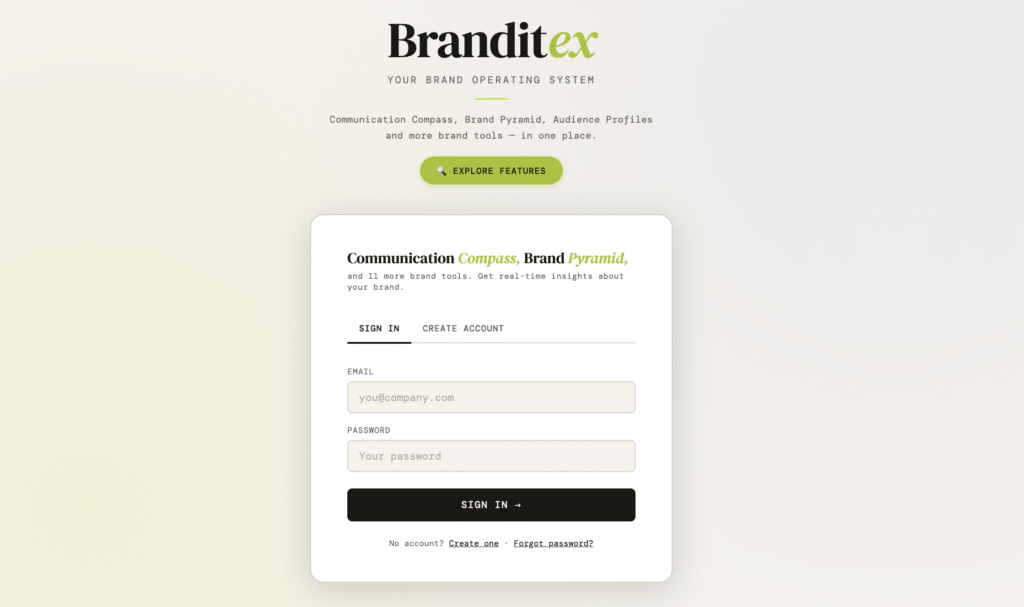
The Brand Platform pyramid covers all seven strategic sections: Mission, Vision, Positioning, Values, Voice, Brand Essence, and Visual Identity. Each section is editable, connected, and synced — update your positioning and it reflects across the Communication Compass, Positioning Map, and Communication Tone settings automatically. The completeness progress bar shows what’s documented and what still needs input.
Beyond the pyramid, Branditex structures the audience definition, competitive landscape, reasons to trust, and brand history — the contextual information that gives the visual system meaning and gives AI tools the data they need to produce on-brand output. When everything is filled in, a complete brandbook exports to PDF with one click.
For small and medium businesses, Branditex compresses the brandbook development process from months to hours. For agencies managing multiple client brands, it functions as the strategic document layer that keeps every brand’s system organized, current, and accessible without the version-control chaos of file-based documentation.
Together, Figma and Branditex cover what a printed brandbook can’t: the visual system in a live design environment, and the strategic foundation in a structured, always-current platform.
Why This Matters More Than It Sounds
Brand consistency drives 23–33% revenue growth, according to Lucidpress research cited consistently across multiple industry studies. That outcome requires that every person touching the brand has access to the current, correct brand system — not the version that was printed eighteen months ago.
A printed brandbook makes brand consistency theoretically possible and practically difficult. A digital brandbook makes it the default state. A responsive brandbook makes it actively supported by every AI tool the team uses.
The argument for printed brandbooks usually comes down to aesthetics and nostalgia. It feels more real. It feels more serious. It photographs well. These are legitimate feelings about a beautiful object, and they’re worth precisely nothing when a contractor in another country is using a deprecated logo on a campaign that goes live tomorrow.
The brandbook is not a trophy. It’s infrastructure. Infrastructure needs to work where the work happens — which in 2026 is online, in Figma, in collaborative platforms, and inside AI tools that need structured brand data to produce consistent output.
Print the brandbook when the brand turns ten and you want to commemorate the decade. Work from the digital system every other day of the year.