There’s a question I get in almost every new client conversation: “How long does a brandbook development process take?” The honest answer is: it depends entirely on what you’re building and for whom. A Fortune 500 rebrand and a five-person e-commerce startup both end up with documents called brandbooks. The process that produces them has almost nothing in common.
Understanding the brandbook development process properly means understanding this first: the depth, duration, and cost of the process should be proportional to the size of the organization that needs to use the output. A 60-page brand architecture document for a team of three is a waste of everyone’s time and money. A 10-page style cheat sheet for a company with 40 people producing brand materials is a liability.
What follows is the full process — the one agencies use for companies that need it — and a clear-eyed view of where that process can be compressed or replaced for businesses that don’t.
Why the Process Matters Before the Document
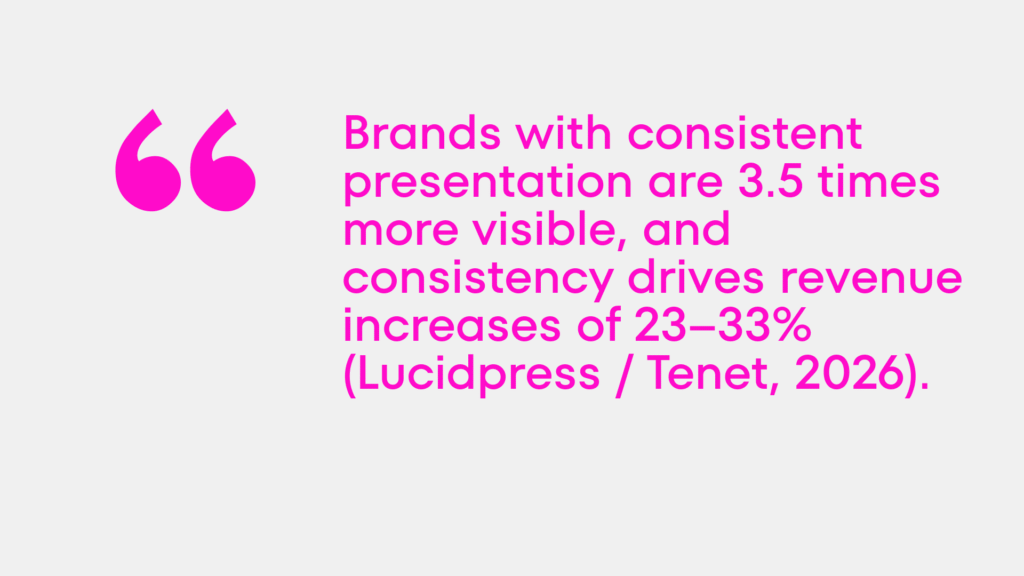
Companies with documented brand consistency frameworks report 10–20% revenue growth year-over-year, compared to companies without them — a finding from a Forrester Research analysis of 3,100 businesses across SMB and mid-market segments (2026). Brands with consistent presentation are 3.5 times more visible, and consistency drives revenue increases of 23–33% (Lucidpress / Tenet, 2026).
But here’s what those statistics don’t say: the document alone doesn’t produce those results. A brandbook that nobody uses, that was built without the research to make it credible, or that documents aesthetic preferences rather than strategic decisions — that produces nothing. The process is what makes the document meaningful. Skip the process and you have a PDF, not a brand system.
───
Stage 1: Discovery and Stakeholder Interviews
Every serious brandbook development process begins with listening. Not presenting, not designing — listening.
Discovery involves structured interviews with the people who define, deliver, and experience the brand. That means founders and senior leadership (what do they believe about why this business exists and where it’s going?), frontline team members (how do they describe the company to strangers?), and ideally a sample of actual customers (why did they choose this brand over alternatives, and what would make them leave?).
The questions that matter at this stage aren’t creative. They’re diagnostic:
• What does this company genuinely do better than its competitors?
• Where does the current brand fail to communicate the actual value?
• What does the company want to be known for in five years that it isn’t known for today?
• What do customers say when they recommend the company to someone else?
Depth interviews with 5–10 stakeholders typically surface the tensions, misalignments, and hidden insights that no brief document can capture. Often the most important finding is a disagreement — the founder and the sales director have fundamentally different ideas about what differentiates the company. That disagreement needs to be resolved before any positioning work starts. Design can’t fix a strategic contradiction.
Duration at agency level: 2–4 weeks for research and interview compilation.
───
Stage 2: Market and Competitive Analysis
Discovery tells you what’s true internally. Competitive analysis tells you what the external landscape looks like and where there’s space to operate.
This stage maps the communications, visual language, and positioning claims of direct competitors, indirect competitors, and category benchmarks. The output isn’t a list of what competitors do — it’s a map of what’s been claimed, what’s overcrowded, and what’s been left unsaid.
Tools like competitive positioning matrices, visual landscape audits, and communication channel mapping (what channels each competitor uses and how intensively) give you a clear picture of the market before any strategic claims are made.
The research methods used at this stage include depth interviews with customers of competitor brands, social listening, semiotic analysis of visual languages across the category, and quantitative data on market positioning (Designbridge, 2025). Not every engagement requires all of these. The goal is to know enough about the competitive environment to make a positioning claim that is both true and differentiated.
Duration at agency level: 2–3 weeks.
───
Stage 3: Brand Platform Development — Mission, Values, Positioning
This is the most consequential stage of the brandbook development process. Everything that follows — the visual identity, the tone of voice, the communication guidelines — is derived from decisions made here.
Mission is the operational purpose of the brand. Not the aspirational version (“to make the world better”) but the functional one: what does this company do, for whom, and why does that matter beyond generating revenue? A well-crafted mission statement is specific enough that it excludes things the company could do but shouldn’t — because they’d contradict the core purpose.
Vision is the long-term destination: what does the company look like when it’s succeeded? Not a financial target, but a picture of the role the brand plays in its market and in the lives of its customers.
Values are the principles that govern decisions when the right choice isn’t obvious. Two or three real values — ones that actually constrain behavior — are worth more than six aspirational ones that everyone agrees with and nobody acts on. The test for a real value: can a team member use it to say no to something? If the answer is never, it’s not a value, it’s a wallpaper.
Positioning is the single most defensible claim the brand makes. Who it’s for, what it does for them, and why it does it better than the alternatives. This is the sentence every other sentence in the brandbook should be traceable back to.
Audience definition at this stage goes beyond demographics. Behavioral profiling — when do customers need this product, what state are they in when they reach for it, what do they believe about the world that makes them receptive to this brand’s values — is more useful for communication decisions than knowing that customers are 35–50 with medium household income.
Brand history is the narrative of how the company came to exist and what it’s learned. It’s not marketing copy — it’s the authentic story that gives the brand’s claims credibility and humanity. History matters because it’s the one thing competitors can’t copy.
Duration at agency level: 3–5 weeks including workshop sessions, iterations, and sign-off.
───
Stage 4: Visual Identity System in a Brandbook Development
With the brand platform approved, visual identity development begins. This is where strategy becomes visible.
The brief to the design team isn’t “make it look professional” — it’s the positioning statement, the audience portrait, the competitive landscape, and the values. Every visual decision — logo system, color palette, typography, imagery direction, iconography — should be traceable to something in that brief.
Evidence-based design methodology removes subjectivity from this process. Color, form, and typographic choices are mapped against the competitive landscape to identify what’s overused (and therefore invisible) and what’s available (and therefore distinctive). The result is design decisions argued from evidence rather than aesthetic preference.
The deliverables at this stage include:
• Primary and secondary logo system with all variations
• Color palette with HEX, RGB, and CMYK codes
• Typography system with hierarchy rules
• Imagery and photography direction
• Iconography and graphic elements
• Application examples across key touchpoints
Duration at agency level: 4–8 weeks depending on scope.
───
Stage 5: Tone of Voice and Messaging Framework in a Brandbook Development Process
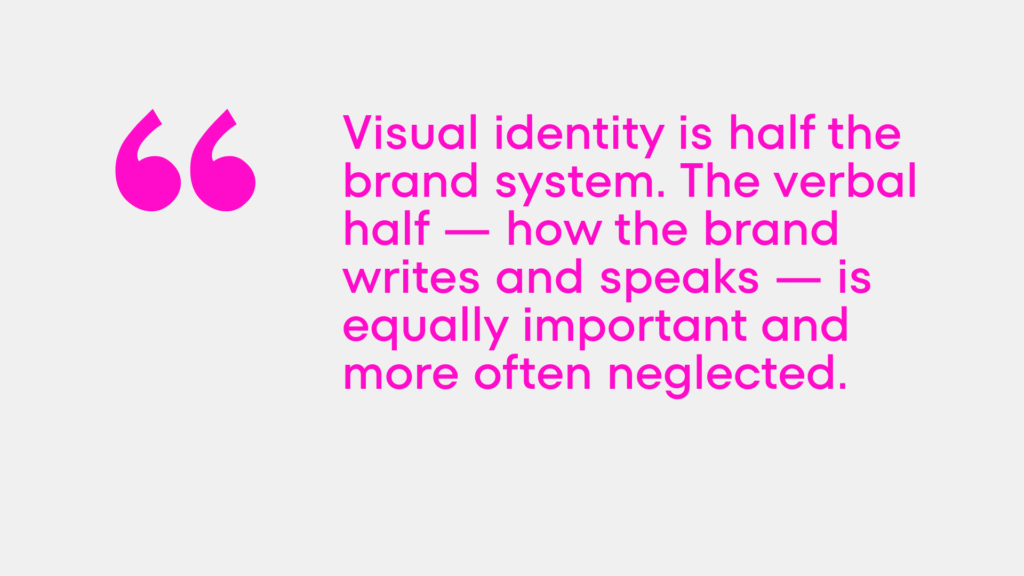
Visual identity is half the brand system. The verbal half — how the brand writes and speaks — is equally important and more often neglected.
Tone of voice documentation defines three or four principles for how the brand communicates, with examples showing the same content written in-brand and out-of-brand. It should also document what the brand never says — the linguistic guardrails that prevent the drift that happens when multiple people write for the brand without shared principles.
The messaging framework adds the structural layer: what the brand leads with (the primary claim), what supports it (proof points and secondary messages), and how these adapt across different audiences and contexts.
Duration at agency level: 2–3 weeks.
───
Stage 6: Document Compilation and Internal Launch in a Brandbook Development
The final stage assembles everything into the brandbook document, adds usage guidelines and prohibited uses, and prepares the internal activation.
The internal launch is not a formality. A brandbook that teams haven’t been walked through is a brandbook that doesn’t work. A brandbook development session with cross-functional leaders — explaining not just the rules but the reasoning behind them — is what converts a document into a living system.
Total agency process duration: 3–6 months. Investment: $5,000–$50,000+ depending on company size and scope.
───
The Path for Small Businesses: Branditex
Here’s the honest assessment: the full agency process above is built for companies with the complexity to justify it. A team of 50 with multiple agencies producing materials needs that level of rigor. A team of five building their first brand presence does not.
For small businesses, Branditex.com compresses the brandbook development process into something that can be completed in hours rather than months — and at a fraction of the cost.
The platform guides you through the same strategic building blocks the agency process covers:
• Brand Pyramid — fill in all seven sections: Mission, Vision, Positioning, Values, Personality, Brand Essence, and Visual Identity
• Audience — define your target customer with behavioral and demographic detail
• Reasons to Trust — document the proof points that make your brand claims credible
• Competitors — map your competitive landscape and your differentiation
• Brand History — capture the authentic story that gives your brand depth
When everything is filled in, Branditex generates your complete brandbook document with one click. Every section syncs automatically — when you update positioning, it reflects across the Communication Compass, Positioning Map, and Communication Tone settings. A completeness progress bar shows what’s done and what still needs input. The output exports to PDF for immediate use.
This is 10 times faster than the agency process, and for a small business — a startup, a local brand, a solo consultant, a growing e-commerce operation — it’s the right tool for the current stage.
The strategic inputs are the same. The rigor of thinking through mission, values, positioning, and audience is the same. What changes is the overhead: no 6-month engagement, no $15,000 investment, no waiting for an agency’s timeline to clear.
The brandbook development process isn’t one thing. It’s a spectrum, and the right entry point depends on where you are today — not where you want to be in five years. Build what your current organization can use, use it consistently, and expand it as the company earns the complexity.