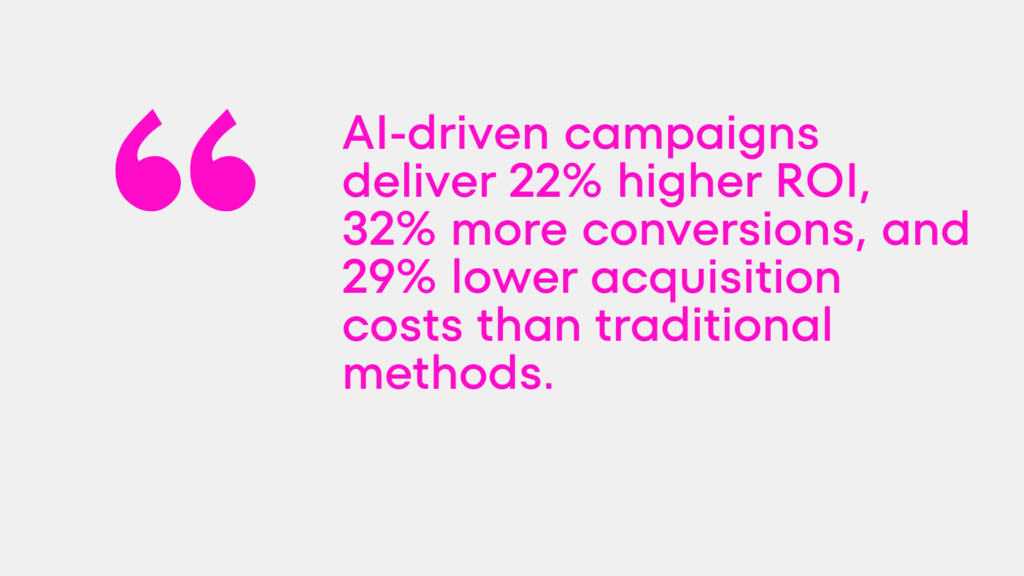
Reading Blue Ocean Strategy by Chan Kim for the second time, I kept returning to one idea: the most dangerous competitive position isn’t being worse than your competitors — it’s being identical to them. The same tools, the same process, the same timelines. Same inputs, same outputs, same results. That’s exactly what’s happening right now in marketing. Companies still running traditional strategy processes are not just slower than their AI-augmented competitors. They’re structurally identical to each other — and structurally outmatched by whoever moved first. AI marketing strategy delivers 22% higher ROI, 32% more conversions, and 29% lower acquisition costs than traditional methods.
Campaigns powered by AI launch 75% faster (Mindcentrix, 2026). McKinsey’s 2025 Global AI Survey found that businesses using generative AI in marketing and sales saw 5–10% real revenue growth, with two-thirds reporting higher revenues. Forrester found a median ROI improvement of 34% within 12 months of switching to an AI-augmented stack.
These aren’t projections. They’re measurements.
What follows is the honest before/after: every major stage of AI marketing strategy process, compared between the old approach and the AI-augmented one — with specific tools for each.
───
Stage 1: Market Research and Audience Analysis for AI marketing strategy
Before (Traditional)
Market research meant commissioning reports, running focus groups, conducting surveys, and waiting weeks for data to be compiled by an analyst. The output was a static document that was already partially outdated by the time it landed on your desk. Audience analysis meant demographics from a CRM and maybe a few customer interviews if the team had time.
The process was expensive, slow, and produced insight that was broad rather than specific — useful for strategy decks, less useful for the campaign brief that needed to be written next Tuesday.
I’d like to point out that this process, involving interviews and internal insights, remains the most important. AI-based research can’t yet be relied upon 100%.
After (AI-Augmented)
Perplexity AI — for deep research synthesis. Ask it to analyze your market, summarize competitor positioning, and identify emerging audience trends. What previously required a week of desk research happens in 20 minutes, with citations.
SparkToro — audience intelligence tool that shows what your target audience reads, watches, follows, and searches. Real behavioral data, not assumptions.
Claude — for synthesizing research into usable strategic documents. Feed it raw interview notes, survey responses, or competitor materials and ask it to extract audience insights, identify positioning gaps, or draft a competitor analysis table.
For audiences, the Branditex audience module structures audience definition directly inside the brand strategy system — behavioral profiling, customer motivations, and segmentation — so research outputs directly inform brand decisions rather than sitting in a separate document nobody opens.
Time saved: Research phase compresses from 3–6 weeks to 3–7 days.
───
Stage 2: Brand Strategy and Positioning Development for AI marketing strategy
Before (Traditional)
Positioning workshops with stakeholders. Multiple sessions. Facilitated by a consultant. Output: a PowerPoint that gets presented to leadership, debated for two months, revised three times, and eventually approved in a form that resembles the original first draft. The brand pyramid — mission, vision, values, positioning — lives in a slide deck that’s hard to update and harder to distribute.
After (AI-Augmented)
Branditex — the entire brand strategy process in one interactive platform. Fill in the 7-section brand pyramid (Mission → Vision → Positioning → Values → Voice → Essence → Identity), map competitors, document reasons to trust, record brand history, and export a complete brandbook with one click. Positioning syncs automatically across the Communication Compass, Positioning Map, and Communication Tone settings.
For positioning hypothesis testing: Claude accelerates what used to require a strategist and three stakeholder meetings. Describe your business, your competitors, and your target audience. Ask Claude to generate five positioning options, stress-test each against the competitive landscape, and identify which is most defensible. Use the output as the starting point for a focused workshop — not the entire workshop.
For competitive positioning visualization: build a simple positioning map internally using Claude. Describe competitors and axes. Ask it to generate a data table. Drop it into a visual tool.
Time saved: Brand platform development from 6–10 weeks → 1–2 weeks. Small business: hours.
───
Stage 3: Content Strategy and Planning for AI marketing strategy
Before (Traditional)
Content strategy started with a brainstorm. Then a spreadsheet. Then a content calendar built in that spreadsheet, usually by whoever had the most patience for Excel. Keyword research happened in SEMrush for those who had a subscription, or didn’t happen at all. Content briefs were written manually, one by one, by a strategist who then handed them to a writer who interpreted them differently than intended.
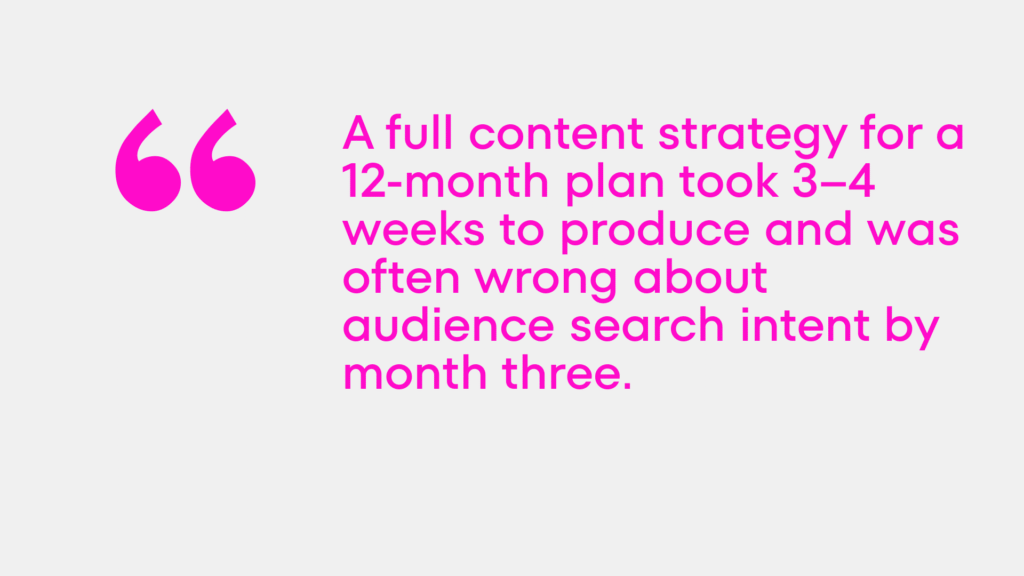
A full content strategy for a 12-month plan took 3–4 weeks to produce and was often wrong about audience search intent by month three.
After (AI-Augmented)
Ahrefs with AI features — keyword research, content gap analysis, competitor content audits. Find what your audience is actually searching for, identify where competitors are winning, and surface the topics where you can realistically rank.
Claude — content brief generation at scale. Feed it your positioning statement, target keyword, audience definition, and competitor URLs. It produces a structured brief: angle, headline options, H2 structure, key points to cover, internal link suggestions. What took 45 minutes per brief now takes 5.
Notion AI — content calendar, editorial database, brief storage, and AI-assisted drafting in one workspace. The calendar connects to the brief connects to the draft connects to the published URL. No more spreadsheet archaeology.
Time saved: Content strategy and brief creation: 60–80% faster.
───
Stage 4: Campaign Planning and Budget Allocation for AI marketing strategy
Before (Traditional)
Campaign planning meant a spreadsheet. Channels listed in rows. Budget allocated in columns. Formulas calculating reach, frequency, CPM, projected conversions. Then the client edited a cell, broke a formula, and sent it back. The media plan was rebuilt for every campaign from scratch. Budget optimization was manual: check results, update a number, recalculate.
After (AI-Augmented)
Purpose-built marketing calculator — instead of rebuilding campaign models in Excel every time, build a browser-based calculator once (using Claude as the development partner) that handles channel selection, budget inputs, reach and conversion projections, and cost-per-acquisition calculations in a clean interface. Excel becomes the export format, not the working environment.
HubSpot with AI features — campaign management, attribution tracking, and AI-powered budget recommendations based on historical performance data. The system learns what performs and adjusts recommendations accordingly.
Foreplay — competitive ad intelligence. See what ads competitors are running, how long they’ve been running (an indicator of what’s working), and use it to inform creative direction before spending budget on hypotheses competitors have already answered.
Time saved: Campaign planning from 2–3 days → 2–4 hours. Budget optimization: continuous rather than manual.
───
Stage 5: Content Creation and Production for AI marketing strategy
Before (Traditional)
A copywriter writes. An editor edits. A designer designs. The process is sequential: one step can’t start until the previous one finishes. A social media calendar of 20 posts takes a full week of coordination. A landing page takes 10 days. An email sequence takes two weeks. Everyone is a bottleneck for everyone else.
After (AI-Augmented)
Claude — first-draft copy for any format: ads, landing pages, email sequences, social posts, product descriptions. The writer’s job shifts from producing first drafts to editing and improving them — a fundamentally different and faster workflow.
Midjourney — visual concept generation for campaigns. Explore creative directions before commissioning photography or illustration. Use outputs as mood boards or reference for designers.
Canva AI — template-based production with AI text and image generation. For social content at volume, this compresses design time by 70% or more.
ElevenLabs — AI voice generation for video narration, ads, and audio content. Removes the voiceover production cycle entirely for content that doesn’t require a human presenter.
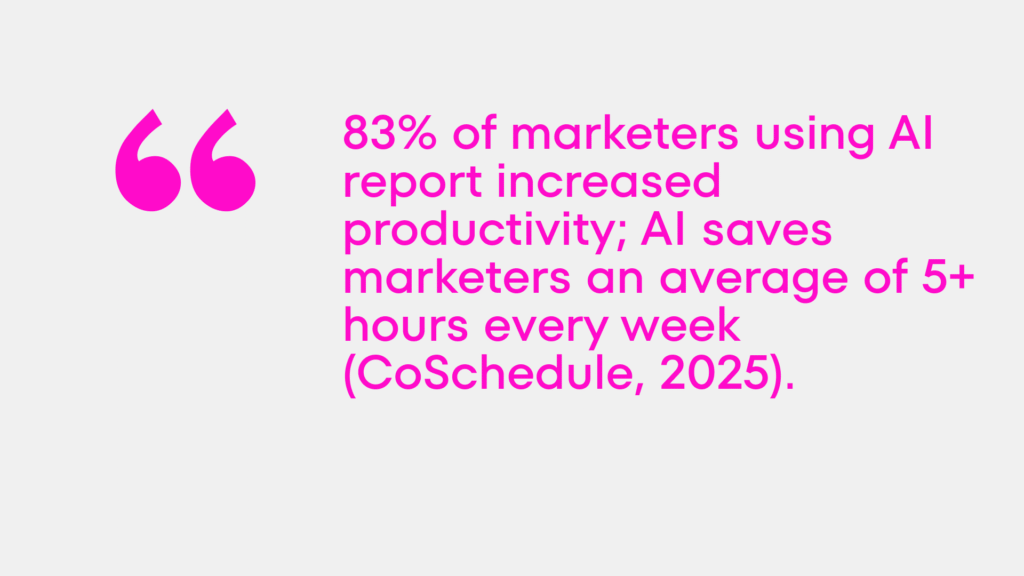
Time saved: Content production cycle: 50–70% faster across formats. 83% of marketers using AI report increased productivity; AI saves marketers an average of 5+ hours every week (CoSchedule, 2025).
───
Stage 6: Analytics, Reporting, and Optimization for AI marketing strategy
Before (Traditional)
Analytics lived in Google Analytics, pulled manually into a report template once a month by whoever owned the reporting task. The report described what happened. It rarely explained why. Optimization decisions were made in the next planning meeting, 2–4 weeks after the data was available.
After (AI-Augmented)
GA4 with Gemini insights (analytics.google.com) — AI-generated anomaly detection, audience insights, and predictive metrics built into the analytics platform.
Triple Whale — AI-powered marketing attribution for e-commerce. Connects ad spend across channels to actual revenue with a clarity that manual attribution modeling can’t match.
Claude — analytics interpretation. Export your data, paste it into Claude, and ask it to identify what drove performance changes, what the top three optimization opportunities are, and what to test next. What was a two-hour analyst task becomes a 10-minute briefing.
Time saved: Reporting cycle from monthly → continuous. Insight-to-action time: days instead of weeks.
The time argument is the easy one. The more consequential argument is the quality one: AI marketing strategy doesn’t just move faster — it tests more hypotheses, personalizes more precisely, and compounds learning faster. Companies using AI across three or more marketing functions see a 32% year-over-year ROI improvement (Rankz, 2026).
The gap between teams that have restructured around AI and teams that haven’t is widening. Not because AI does the thinking — it doesn’t, and it shouldn’t. Because AI removes the friction that was preventing the thinking from becoming action.